
Slow VPN? Find the Bottleneck Before You Tune It
- First Prove the Internet Isn't Already Slow
- Test the Task, Not Only the Big Number
- The Nearest Server Is the First Guess, Not the Verdict
- Change the Protocol Before the Obscure Settings
- A Router Can Be the Ceiling
- Software Can Build a Traffic Jam Inside the Laptop
- MTU Is a Late Test for a Peculiar Failure
- Travel Hardware Trades Portability for Headroom
- Privacy Features Spend Performance on Purpose
- Give Support a Test They Can Reproduce
The VPN gets blamed because it's the button you just pressed. Meanwhile, the laptop is clinging to weak hotel Wi-Fi, the nearest server has a terrible route, and a low-power router is trying to encrypt a gigabit plan.
Don't tune all three. A slow VPN becomes fixable when you find the first place speed disappears. Measure the plain connection, add the tunnel, change one variable, and keep the result.
First Prove the Internet Isn't Already Slow
Sam disconnects the VPN and runs three nearby speed tests. Then Sam does the task that actually hurts: joins a call, opens the work portal, and uploads the same file. Download, upload, and latency go into a note with the time.
Without the VPN, Sam's device sends traffic through the hotel network and ISP to each destination. The hotel and ISP can see the usual connection metadata and destinations not hidden by other encryption. The site sees the hotel's public IP. If that route already stutters, the VPN didn't create the first problem.
Restart the local router if you control it, move closer to Wi-Fi, test another device, and try Ethernet. Microsoft explicitly uses a working wired connection as evidence that the problem lies in the Wi-Fi side of the path. A full signal icon doesn't prove the radio channel is quiet.
Now connect the VPN and repeat the same test in the same window. The device encrypts covered traffic to the VPN server. The hotel sees that tunnel plus timing and volume. The VPN provider sees Sam's source connection and the destination infrastructure it forwards traffic toward, while HTTPS still protects secure session contents. The destination sees the VPN exit IP. Any added loss can now belong to encryption, the device, the VPN server, or the new network path. A small, stable drop can simply be normal processing and route overhead.
Don't compare a 7 a.m. wired baseline with an 8 p.m. Wi-Fi VPN test. Same device. Same network. Same destination. Same time window. Otherwise, the result is a story, not a measurement.

Test the Task, Not Only the Big Number
A speed test can report high throughput while a call still freezes. Calls and games care about latency, jitter, and loss. Large downloads care more about sustained throughput. Web pages can feel broken when DNS or MTU trouble stalls only certain requests.
Pick a test that matches the complaint. For a call, watch delay and dropouts. For streaming, run the same permitted video for long enough to reveal buffering. For uploads, send the same non-sensitive test file.
Run each test several times. One burst can catch a quiet server or a lucky route. The useful result is the one that survives normal use.
The Nearest Server Is the First Guess, Not the Verdict
Distance adds travel time. Start with a nearby VPN location unless you need a particular country. Then test two neighboring locations, because the dot that looks closest on a map may take a worse route across the internet.
If the app shows load, try a lower-load server in the same region. Treat the percentage as a snapshot, not a diagnosis. The path between Sam and the server can be congested even when that server reports spare capacity.
Evening slowdown needs a paired test. If both the direct and VPN routes collapse at 8 p.m., suspect local or ISP congestion. If only one VPN server collapses, switch within the region and reproduce it.
Change the Protocol Before the Obscure Settings
WireGuard is a sensible first test on current devices. Its official project describes a small, cross-platform design built for high performance. OpenVPN remains useful for compatibility and for networks that need a different transport.
On a supported mobile client, IKEv2 can be worth testing because MOBIKE is designed to preserve the VPN as network addresses or interfaces change. That reconnection advantage is qualified: the app and server must support it, and it doesn't guarantee higher throughput.
If OpenVPN is selected, try UDP first. OpenVPN's own TCP-meltdown explanation warns that carrying TCP traffic inside a TCP VPN tunnel can cause competing retransmissions and sharp performance trouble. TCP can still be the route that passes a restrictive network; it just isn't a free speed upgrade.
Change only the protocol. Reconnect to the same location. Repeat the same call or file. If you change protocol, server, DNS, and obfuscation together, the winning move stays hidden.
A Router Can Be the Ceiling
Encryption and packet handling consume processing time. A current laptop may fill the internet connection while an older or low-power router hits its CPU limit far earlier.
Compare the provider's native app on a capable computer with the same service running on the router. Keep the server and protocol as close as possible. If the app is fast and the router is slow, the tunnel provider isn't the only suspect.
A GL.iNet Flint 2 is an example of newer home hardware built to run compatible WireGuard or OpenVPN profiles, but a product card isn't a benchmark for your line, firmware, or configuration.

- Pairs Wi-Fi 6 and dual 2.5-gigabit ports with enough capacity for a device-heavy household
- Runs WireGuard and OpenVPN directly on the router so compatible devices can share one VPN policy
- Supports AdGuard Home and OpenWrt customization, with an initial firmware update recommended
Before buying anything, update the current router, check processor use if the interface exposes it, and test Ethernet through the native app. If replacement is justified, verify current firmware, measured VPN throughput for your protocol, DNS controls, and fail-closed behavior. The speed printed on the ISP bill isn't the speed every router can encrypt.
Software Can Build a Traffic Jam Inside the Laptop
Antivirus web filters, firewalls, parental controls, custom DNS apps, browser proxies, and a second VPN can all inspect or reroute the same traffic. Disable one component only long enough to diagnose, then restore protection before moving to the next.
Update the VPN app, operating system, network driver, and router firmware. Old components can trigger retransmissions, failed sleep recovery, and protocol bugs that look like an overloaded server.
Watch processor and memory use during the test. A video editor, cloud sync, operating-system update, or browser with fifty active tabs can consume the same CPU, disk, and bandwidth the tunnel needs.
Then test a clean browser profile or another browser. An extension can add a proxy or content filter inside the VPN route, giving Sam two intermediaries to blame.
MTU Is a Late Test for a Peculiar Failure
The maximum transmission unit is the largest packet a link can carry in one piece. A VPN adds headers, so the usable size inside the tunnel can be smaller than the local network suggests.
An MTU problem often looks stranger than “everything is 20% slower.” A connection begins, small requests work, then a page, upload, or file transfer hangs. The IETF's IPv6 Path MTU standard describes black-hole connections that complete a TCP handshake and then stall when oversized packets meet a path that can't report the limit correctly.
Use the provider's automatic MTU first. Change it only with platform- or provider-specific instructions, record the original value, and retest the same broken destination. Don't copy a magic number from a forum into every device.
MTU belongs after baseline, Wi-Fi, server, protocol, hardware, and conflicts. Most slow VPNs don't need packet surgery.
Travel Hardware Trades Portability for Headroom
A pocket router can make hotel setup easier and carry one VPN policy for several devices. It can also add another Wi-Fi hop and another processor to the path.
The GL.iNet Slate AX is a faster-class travel option than tiny entry-level hardware and supports compatible WireGuard and OpenVPN profiles. That still doesn't promise the throughput of Sam's laptop.
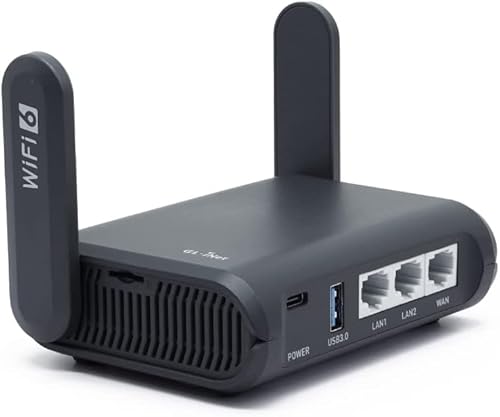
- Builds a private Wi-Fi 6 network for laptops, phones, streaming devices, and other travel gear
- Runs OpenVPN or WireGuard for compatible VPN services, with performance suited to faster connections
- Handles hotel captive portals and includes a configurable switch for VPN or network-wide filtering
Test it in layers. First use the hotel's connection directly when safe and permitted. Then connect through the travel router without VPN: the router forwards ordinary traffic, the hotel sees those direct routes, no VPN provider participates, and destinations see the hotel IP. Finally add the tunnel: the router encrypts covered traffic to the VPN server, the hotel sees that server connection, the VPN provider sees the source connection and destination infrastructure it forwards toward, and destinations see the VPN exit IP. The step where performance falls identifies the route to inspect.
Check captive-portal behavior, firmware, radio band, Ethernet options, VPN protocol, and measured throughput before buying. Portability is useful. It isn't extra bandwidth.
Privacy Features Spend Performance on Purpose
Multihop, obfuscation, traffic padding, deep filtering, and distant exits can add travel, processing, or data. Turn them off for the baseline. Then add only the feature your network or threat model needs.
If a normal nearby route works and a two-hop route slows the call, nothing mysterious happened. Sam's device still tunnels to the provider; the local network still sees the encrypted connection; the provider carries it through more infrastructure; the destination sees the final exit. The longer internal trip is the trade.
Don't chase the fastest result past the point of safety. A fast tunnel that fails a DNS leak test or IP leak test, opens during a network change, or sends an excluded app directly may be the wrong result. “Fast enough and stable” beats one heroic test.
Give Support a Test They Can Reproduce
Send the device, operating system, app version, protocol, server, network type, test time, direct baseline, connected result, and affected task. Include whether the problem survives another nearby server and another network.
That record tells support whether to investigate a server, route, app, or known platform issue. It also stops you from circling through the same settings at midnight.
The fix is usually ordinary: repair the base connection, shorten the route, leave a crowded server, change one protocol, remove a conflict, or move encryption off weak hardware. Measure first. The bottleneck gets much less mysterious when it has nowhere left to hide.