
Hulu With a VPN: What the Location Error Really Means
Maya lands in London, opens the show she saved for dinner, and Hulu rejects the connection. A New York VPN server can change her IP address. It can't turn overseas viewing into supported Hulu access.
That distinction matters before the trip, not after the error. Hulu's current subscriber agreement says the Hulu service is available only in the United States and certain U.S. territories, and that content can vary by rights, plan, location, law, and blackout rules.
A VPN may still be useful for Maya's email and browsing on hotel Wi-Fi. It just isn't a durable ticket through a streaming service's location checks.
A U.S. IP Address Is Only One Vote
When Maya connects to New York, the hotel sees encrypted traffic going to the VPN server. The VPN operator receives that tunnel. Hulu sees a request from a shared server address instead of the hotel's British address.
Hulu can use more than that address. Its agreement says it may verify location through different technologies and may require location sharing on some devices. Account history, the connection type, a Live TV Home setting, and device location permissions can all make “New York” less convincing than the map pin in the VPN app.
Commercial VPN exits also put many customers behind a small pool of addresses. A service can classify a known data-center range or respond to patterns associated with one shared IP. An exit that works tonight can fail after the service changes its checks.
An unknown free proxy adds a worse risk: don't send Hulu or MyDisney credentials through an operator you can't identify.
That is why server roulette isn't a travel plan. It is a temporary experiment whose result Hulu controls.

Live TV Has a Home, Not Just a Location
Hulu + Live TV adds another layer. Subscribers designate a residential, non-mobile internet network as Home, and that setting helps determine in-home and out-of-home streams. The agreement also tells mobile viewers to access the service from Home periodically; the Help Center carries the current interval and procedures.
Local affiliates, regional sports, and live events can depend on the device or Home location. Blackouts come from content rights, not a weak encryption setting. Hulu's program-availability guide points Live TV viewers to network coverage, Home/on-the-go rules, and sports availability for exactly that reason.
Changing the visible IP doesn't rewrite those rights. It can instead make a television look as if it left Home.
A Proxy Error Is a Routing Clue
Back in the United States, imagine Hulu throws an anonymous-proxy or location error on the living-room TV. Start by restoring the plain route: disconnect VPNs, proxies, Smart DNS, and privacy relays, fully close Hulu, then try the ordinary home connection again.
Check the device's date, time zone, and location permission. Restart the viewing device and router if the address or route may be stale. On a computer, Hulu notes that location services may be required when signing in.
If the error survives on the ordinary connection, contact the ISP and Hulu support with the error code, device, connection type, and public-IP location. Don't paste the full address into a public forum.
The Hidden VPN May Be in the Router
No VPN app on the TV doesn't mean no VPN route. A work profile, antivirus suite, browser extension, custom DNS service, Apple privacy feature, or router policy can change where traffic goes.
Inspect the device and router separately. A router rule may send the TV through a tunnel even while a nearby phone uses the normal WAN. Don't remove a managed work profile; test a personal device on an ordinary network instead.
A home router with policy controls can make that split explicit. The GL.iNet Flint 2 below is relevant when one household wants separate routes for different devices. Verify firmware, protocol support, and the exact policy before buying; the hardware can't make Hulu accept a VPN exit.

- Pairs Wi-Fi 6 and dual 2.5-gigabit ports with enough capacity for a device-heavy household
- Runs WireGuard and OpenVPN directly on the router so compatible devices can share one VPN policy
- Supports AdGuard Home and OpenWrt customization, with an initial firmware update recommended
Write the rule down, including which devices bypass the tunnel and why. Recheck it after firmware updates or a new streaming box joins the network. Forgotten exceptions are how a convenient fix becomes a permanent privacy gap.
Split Tunneling Fixes Access by Removing Protection
On a U.S. home network, app-level split tunneling may let Hulu use the ordinary connection while other apps keep using the VPN. That can solve a location conflict because Hulu no longer receives the VPN server's IP.
The exception has a cost. The excluded Hulu app uses the normal route, so the ISP sees its connection in the usual way and Hulu sees the household's public IP. The VPN provider doesn't carry that excluded traffic. Meanwhile, covered apps still travel through the encrypted tunnel and emerge from its server.
That's the complete comparison: the device chooses the path; the local network sees direct Hulu traffic or an encrypted VPN connection; the VPN operator sees only the covered route; Hulu sees whichever public IP arrives. Split tunneling doesn't protect Hulu and satisfy Hulu simultaneously. It chooses access over tunnel coverage for that app.
Streaming devices may call helper services outside the obvious app process. Test playback, ads, sign-in, and casting rather than assuming one checkbox captured every domain.
Download Before the Suitcase Closes
Maya's dependable option is preparation. Hulu says subscribers to eligible Premium plans can download a selection of library titles on mobile devices. Check the plan, title, device, expiration rules, and sign-in state while still at home.
Not every program is downloadable, and Live TV isn't transformed into an offline library. Rights can also put the same show on a different authorized service at the destination.
Use the VPN for what it can reliably do on the trip: protect covered traffic between a device and the VPN server on an untrusted local network. If Hulu needs the direct route, close sensitive sessions first, disconnect deliberately, and reconnect the VPN afterward.
A Travel Router Organizes the Choice
With a phone, laptop, and streaming stick in one room, hotel Wi-Fi becomes a tangle of captive portals and per-device settings. A travel router can put those devices behind one network and give you a visible place to choose VPN or direct routing.
The GL.iNet Slate AX below fits that travel-network job. It doesn't authorize overseas Hulu viewing, defeat location controls, or guarantee that a hotel login page will behave; it simply makes the local topology and policy easier to manage when its current firmware supports your setup.
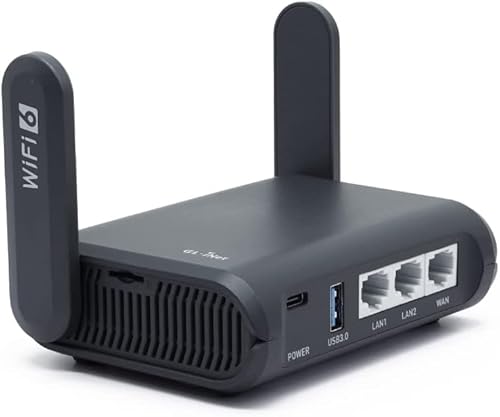
- Builds a private Wi-Fi 6 network for laptops, phones, streaming devices, and other travel gear
- Runs OpenVPN or WireGuard for compatible VPN services, with performance suited to faster connections
- Handles hotel captive portals and includes a configurable switch for VPN or network-wide filtering
Keep the Hulu route ordinary where the service requires it. Keep permitted browsing on the VPN when privacy matters. Recheck both paths after changing the router. One box can simplify the choice, but it can't erase it or change the service's territory.
Treat the Error as an Answer
If Hulu rejects a VPN outside its supported territory, the honest answer isn't an endless list of “working” servers. The service defines eligibility and can change enforcement. A successful connection today isn't a promise for tomorrow.
Inside the United States, strip the route back to basics, check Home and location settings, then add privacy tools one at a time. Before international travel, prepare eligible downloads and find the authorized local distributor. A VPN still has a job—just not the job the play button refused.